

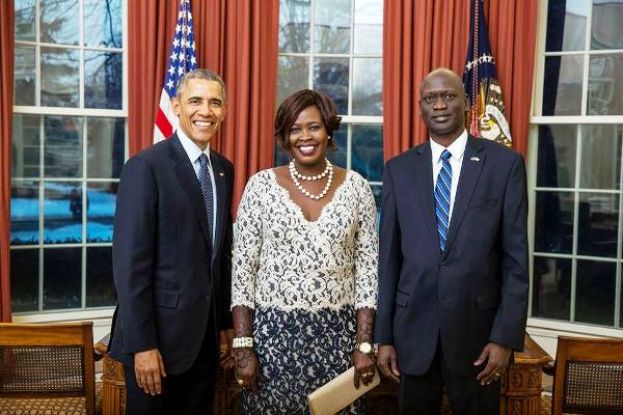

South Sudan’s new ambassador to the United States ambassador Garang Diing Akuong presented his credentials to President Barack Obama in a ceremony at the White House on Monday, February 23.
This happened as the foreignpolicy.com announced that the US had threatened to issue new sanctions against individuals in South Sudan seen to be hindering the peace process.
South Sudan’s new ambassador to the United States ambassador Garang Diing Akuong presented his credentials to President Barack Obama in a ceremony at the White House on Monday, February 23.
This happened as the foreignpolicy.com announced that the US had threatened to issue new sanctions against individuals in South Sudan seen to be hindering the peace process.
The US congratulated ambassador Diing on the challenging new assignment and wished him all the best.
“Together, we look forward to helping secure a peaceful, prosperous and democratic future for the people of South Sudan,” said a statement from the US government.
The new ambassador was accompanied to the White House by his wife Madam Diing during the presentation of his credentials to President Obama.
For the past nine months, the Obama administration has repeatedly warned South Sudan’s warring parties that they could face a raft of targeted U.N. sanctions if they fail to halt a wave of ethnically targeted violence that has plagued the country for more than a year, and pushed its people to the brink of famine. Each time, the administration has put off action, arguing that the diplomatic timing was not quite right.
On Tuesday, U.S. diplomats circulated a draft resolution to the U.N. Security Council that establishes a sanctions committee, as well as an independent panel of experts, to lay the groundwork for possible travel bans and asset freezes on individuals who obstruct peace talks, promote violence, abuse human rights, recruit child soldiers, and impede the work of peacekeepers and aid workers.
Foreignpolicy.com reports that South Sudan’s civil war has dealt a blow to one of America’s most significant bipartisan foreign-policy achievements: paving the way for South Sudan’s independence from Sudan in 2011.
In 2005, President George W. Bush’s administration brokered a political settlement ending one of Africa’s bloodiest civil wars, a decades-long fight between Sudan’s Arab government in Khartoum and southern animists and Christians. The deal resulted in the creation of the world’s youngest country.
But South Sudan descended into civil war in December 2013, in a fight that pitted the country’s president, Salva Kiir, against his former vice president, Riek Machar, and fueled a surge of ethnic-based killings.
The US, the United Nations, and other key powers have condemned the two leaders’ conduct in the war, saying they have put their own personal quests for power above the interests of their people.
The move by the United States came as a senior U.N. human rights official provided the U.N. Security Council with a briefing on a recent trip to South Sudan.
The U.N. assistant secretary general Ivan Simonovic told the U.N. Security Council on Tuesday that though the scale and severity of the conflict has recently declined, the number of displaced and refugees has continued to grow, reaching 2 million people. He said there were thousands more civilians dead and further humanitarian law and human rights violations have been committed by both sides to the conflict.
“Displaced people told me they are frightened. They have nowhere to go. And both sides seem to be rearming and preparing for a new military campaign,” he said.
South Sudan’s U.N. envoy, Francis Deng, is said to have appealed to the council not to pursue sanctions, saying it would only aggravate the situation on the ground in South Sudan and contribute to an adversarial relationship between the council and Juba.
“It would be ironic double jeopardy to punish a country that is already suffering from an acute crisis,” he said.
(Foreignpolicy.com. Additional information by TCT)
BLOG COMMENTS POWERED BY DISQUS
